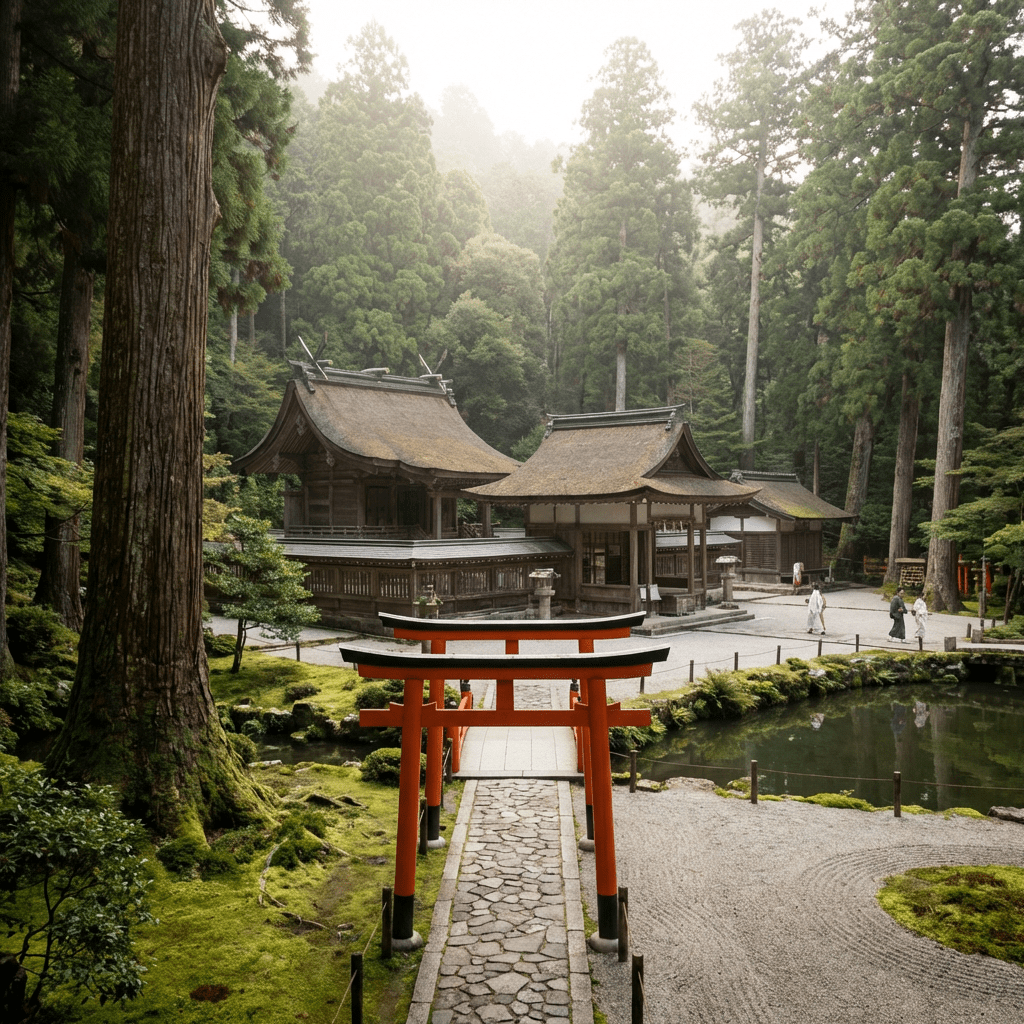
Thank you for revisiting one of my posts! It has got warmer these days in Japan, and I occasionally sense the smell of the Spring around my place. Japanese mainlanders used to divide one year into 24 different periods according to the climate, giving farmers easy instructions to grow their crops. As the earth experienced the equinox day on March 20th, we are heading towards summer in the northern hemisphere and heading towards winter in the southern hemisphere. Talking of the ancient era, it seems that farmers started seeding crops around this period, as there is a minor Japanese traditional day called shajitsu around the equinox, on which farmers pray to their land God for enough harvests in fall of the year. It is interesting to remind that there are several occasions where Japanese used to pray for local Gods in a year, as they used to believe that every single thing, including each rice drop, has its own God instilled inside.
Anyways, I introduced the topic of religion briefly in the last post. Religion has played a significant role in organizing people, building a society, and maintaining the current social structure. In fact, our morale hugely depends on religious beliefs rooted in the local area. For example, Japanese typically cherish harmony within a group rather than profits of one’s sake, because they used to form a group to cooperate cultivating foods, building houses, and protecting a region where the group is located. There were actually a lot of conflicts within country, mainly because shinto, Buddhism, and ancient Chinese religion did not prevail in Japan, resulting in different districts to believe in different kinds of Gods. Although it is commonly perceived that shinto was popular in Japan, it became the official religion in the late 19th century, and the system of official religion only lasted for around 50 years until the US ordered Japanese government to vanish it. However, the stigma that shinto was dominant in Japan definitely emerged due to the second World War, because Japanese were able to unite and advanced its territory thanks to the existence of shinto as an official religion. Since shinto claims the emperor as the God of the whole world, it was natural to follow orders from the emperor for Japanese people believed in shinto. The Japanese government successfully utilized the power of the religion to convince Japanese nations to enter the war. It also helped the government to cover the truths, that Japan lost several fights against the US, leading to the lengthy conflict. If you have any interests in how shintoism perceive the second World War, it may worth visiting a museum besides Yasukuni shrine, Tokyo, Japan. The main point of this paragraph is that existence of religion succeeded in organizing and forming a solid nation that once caused a war and complicated the power balance of the world.
Therefore, religion is a powerful tool to survive in this world. People can use it for organizing a group of people and live peacefully. On the other hand, it could be used to manipulate people’s emotions, possibly leading to disruptive consequences.
Thank you for reading my piece of writing today. Please feel free to leave any comments, including whether you think how people should decide which God to believe in. I hope we will see each other in the next post. I may not be able to post another writing tomorrow, so please come back the day after tomorrow!
Chao!
 Serendipity Daily Thoughts
Leave a comment